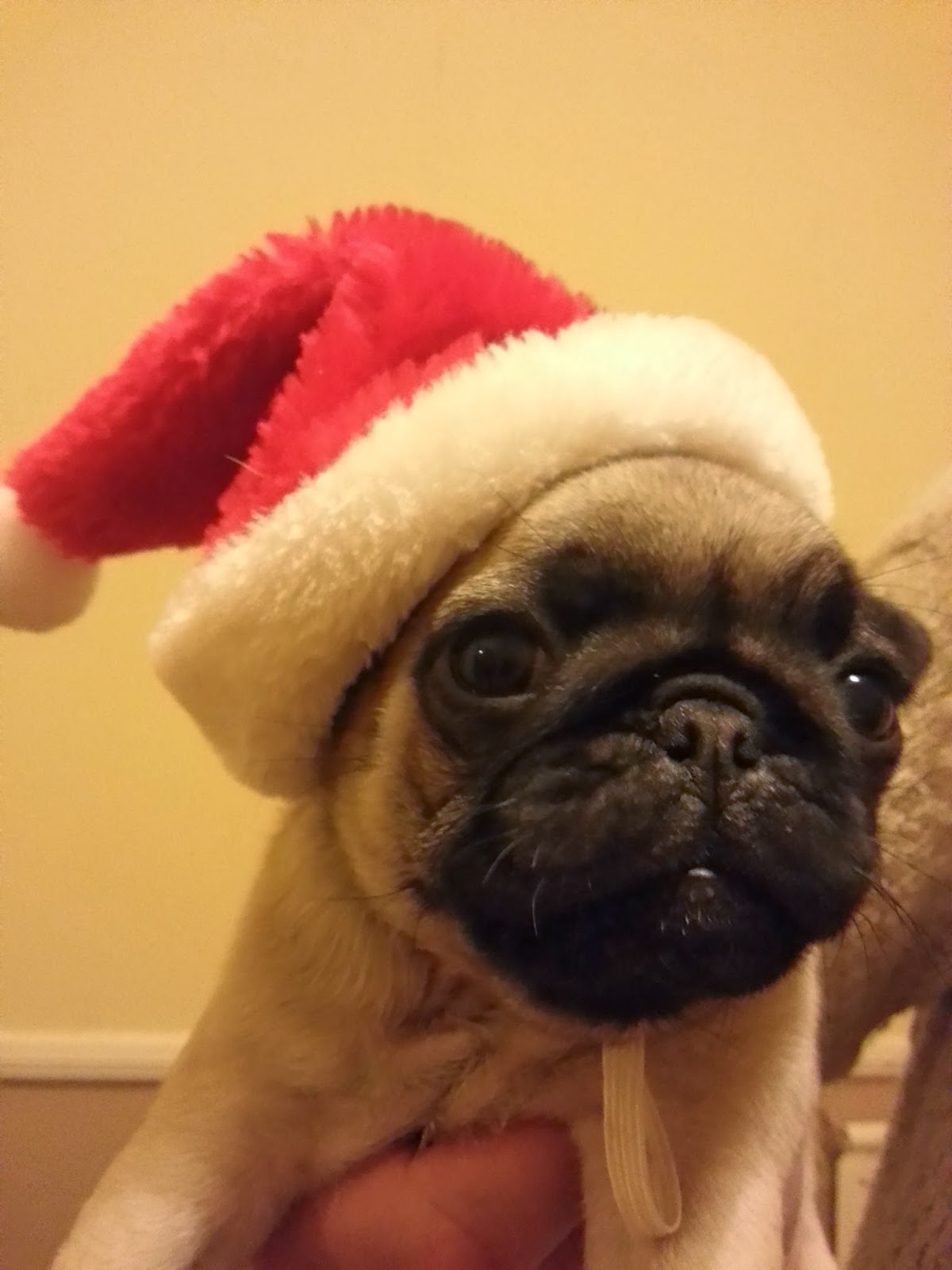
We hope you all had a great Christmas & are looking forward to 2014! The fawns all had their vaccinations & health checks & will be ready to go as planned at 8 weeks old.
See you all soon,
Helen & David
Saturday, 28 December 2013

Fawn pups 7 & 1/2 weeks old, Black pups 5 weeks old
They've finally met & started playing! Here is a quick video of the two litters having some grub together & doing the usual things pugs do. Enjoy!
http://www.youtube.com/watch?edit=vd&v=w5CLFVOjrPQ
http://www.youtube.com/watch?edit=vd&v=w5CLFVOjrPQ
Wednesday, 18 December 2013
New video: Fawns at 6 & 1/2 weeks old.
Here is our latest video of the fawn pups:
http://www.youtube.com/watch?v=NaQ3XumIgN8&edit=vd
It's not award winning production but you get an idea of where the pups are in terms of development. Enjoy!
http://www.youtube.com/watch?v=NaQ3XumIgN8&edit=vd
It's not award winning production but you get an idea of where the pups are in terms of development. Enjoy!
Monday, 16 December 2013


Tuesday, 10 December 2013
Temperature & it's dangers for Pugs.
Your pup will be extremely sensitive to changes in temperature, especially up to the age of around 6 months. Failing to deal with a significant drop or increase in temperature can have serious consequences for your pup & this is something we repeatedly stress to people who get a pug puppy.
We know that we do sound like a broken record with regards temperature but it is so critical to keep your pup warm in winter or at night & suitably cool during summer. The fur on a pug pup, especially in the case of the fawns (where it is a thinner double coat), will continue to grow & develop as they mature into an adult. Areas of thin fur or patches of colour will change as they develop. For this reason we'd stress that from when you collect your pup at 8 weeks old he/she will be nowhere near the finished article. Like we will have stressed to many people, the more care you provide in this critical period of the pup's life, the better the results will be for both you & your dog.
We'd advise you to use a coat whenever you walk your pug pup in winter. A fully grown adult pug will probably not require one at all times unless the temperature is particularly severe (like the snow above). As pugs are a toy breed they are susceptible to the cold like any other small dog. An obvious sign of a pup suffering from cold is shivering.
The flip side to this is that pugs overheat quite easily too in hot conditions. I'm sure everyone nowadays understands the need to avoid leaving dogs of all breeds in hot cars. As pugs have such narrow nasal passages, when they heat up they will invariably pant (like all dogs do) & the rate of this will increase/decrease depending on exertion & temperature. We take water with us when walking our pugs on a sunny day & would advise you to do the same. If the temperature is in the high twenties (celsius) however we'd probably not take them out at all.
We know that we do sound like a broken record with regards temperature but it is so critical to keep your pup warm in winter or at night & suitably cool during summer. The fur on a pug pup, especially in the case of the fawns (where it is a thinner double coat), will continue to grow & develop as they mature into an adult. Areas of thin fur or patches of colour will change as they develop. For this reason we'd stress that from when you collect your pup at 8 weeks old he/she will be nowhere near the finished article. Like we will have stressed to many people, the more care you provide in this critical period of the pup's life, the better the results will be for both you & your dog.
 |
| Flo in her trendy hoody, enjoying the snow. |
The flip side to this is that pugs overheat quite easily too in hot conditions. I'm sure everyone nowadays understands the need to avoid leaving dogs of all breeds in hot cars. As pugs have such narrow nasal passages, when they heat up they will invariably pant (like all dogs do) & the rate of this will increase/decrease depending on exertion & temperature. We take water with us when walking our pugs on a sunny day & would advise you to do the same. If the temperature is in the high twenties (celsius) however we'd probably not take them out at all.
The Kennel Club & why it's important.
We often get asked questions about the Kennel Club & why it's important to select a pup that is registered with them. Firstly, the KC provides a large database for dog registrations that will date back over several generations of a dog's history. From this you can see exactly what type of dog you are buying & that it is pure bred, not crossed with any other breed.

Sadly, although most breeders (especially those with kc accreditation) are reliable, there are many that simply aren't & will try various things in order to simply make money. Puppy farms are the most notorious as they have little or no regard for the health & well being of the dogs (parent or pup). In a puppy farm you could expect there to be a large number of dogs found in an unsuitable & often cramped environment. Other 'dodgy' examples can be adverts that offer pups at a low price but often there is no dog available. You might contact them, as advertising in one location, only for them to ask you to meet elsewhere. It is essential also to see the pup you are buying with the mother so you know where it has come from & that it will be appropriate raised & not maladjusted.
The KC registration obviously comes at a price & provides no guarantee that your pup will not encounter health issues at some point (not unlike humans), but it does offer a platform upon which your pup has the best opportunity to grow & develop fully into an adult dog. The KC also isn't a fool proof system but we feel is the best option out there for genuine breeders.
Often although people seek assurance that their pup is registered with the Kennel Club they don't have a clue what the paperwork actually tells them. The pup that you are buying is obviously at the 'head' or left of the family tree. The next two dogs are the parents & so on to the 5th generation. Should you wish to explore further back or to see the siblings/progeny of any dog registered you can actually do this by registering with the kc website at:
https://www.mykc.org.uk/
"Why the daft names?"
There is actually a valid reason for this. The first word is normally the registered kennel name (or affix) of where the pup is from, eg one of our chosen kennel names is 'puggletricks'. Other kennels with top reputations for breeding include the 'britishglory', 'claybridge' or 'eastonite' kennels etc. This means if you see a pup with that name in it's affix you'll know it came from that particular kennel. The KC block anyone trying to falsely use the kennel names where not applicable. So if you spot a puggletricks etc pup you know it's one of ours.
The second name is often determined by the person buying the pup, or their own kennel name. We set ours up with a generic second name that you are welcome to change should you wish to alter the registration of your pup with the kc (at a price mind). If you were considering breeding then this would be recommended.
So these are simply kennel names & another pointer towards the dog's history, as opposed to a database of dogs simply known by their common names, eg Sandy, Barney etc.
"What do the letters mean?"
Often you will see an abbreviation for a country that a dog may have been imported from, eg Germ = Germany & so on. We have no endorsements on our pups at sale but sometimes people will import/export dogs based on their success at show. Their progeny also may often be sold in a similar way. Again the welfare of the dog has to be the priority & exporting pups around the world is often frowned upon. Some breeders will consequently place an endorsement on their pups that would prevent it from being exported under kc rules. You have to understand that a breeder with a very successful dog at show could command serious money for their offspring. We have had offers to export to India but for obvious reasons turned them down.
CH refers to a champion dog & JW refers to a 'junior warrant' whereby the dog has obtained 25 points between the age of 6-18 months at show. 3 points must also be obtained at Championship Shows for this. As you can see, it can become quite a technical (& competitive) area. In our fawn pups 5 generation pedigree there are 14 champions (a good number we're happy with although you may find less/more in other pups) & there are more in the 6th generation respectively.
As mentioned, this system isn't fool proof & we've actually encountered breeders offering fake kennel club paperwork before. The easiest & most responsible thing to do was to simply report them. What was worse on that particular occasion was that the pups weren't being cared for, fed by a surrogate French Bulldog & at 8 weeks looked around the size of 4 weeks (that's if they were actually 8 weeks at all). So overall we feel a KC pup is without doubt the best way to go.

Sadly, although most breeders (especially those with kc accreditation) are reliable, there are many that simply aren't & will try various things in order to simply make money. Puppy farms are the most notorious as they have little or no regard for the health & well being of the dogs (parent or pup). In a puppy farm you could expect there to be a large number of dogs found in an unsuitable & often cramped environment. Other 'dodgy' examples can be adverts that offer pups at a low price but often there is no dog available. You might contact them, as advertising in one location, only for them to ask you to meet elsewhere. It is essential also to see the pup you are buying with the mother so you know where it has come from & that it will be appropriate raised & not maladjusted.
The KC registration obviously comes at a price & provides no guarantee that your pup will not encounter health issues at some point (not unlike humans), but it does offer a platform upon which your pup has the best opportunity to grow & develop fully into an adult dog. The KC also isn't a fool proof system but we feel is the best option out there for genuine breeders.
 |
| An example of 5 generation kc pedigree certificate |
https://www.mykc.org.uk/
"Why the daft names?"
There is actually a valid reason for this. The first word is normally the registered kennel name (or affix) of where the pup is from, eg one of our chosen kennel names is 'puggletricks'. Other kennels with top reputations for breeding include the 'britishglory', 'claybridge' or 'eastonite' kennels etc. This means if you see a pup with that name in it's affix you'll know it came from that particular kennel. The KC block anyone trying to falsely use the kennel names where not applicable. So if you spot a puggletricks etc pup you know it's one of ours.
The second name is often determined by the person buying the pup, or their own kennel name. We set ours up with a generic second name that you are welcome to change should you wish to alter the registration of your pup with the kc (at a price mind). If you were considering breeding then this would be recommended.
So these are simply kennel names & another pointer towards the dog's history, as opposed to a database of dogs simply known by their common names, eg Sandy, Barney etc.
"What do the letters mean?"
Often you will see an abbreviation for a country that a dog may have been imported from, eg Germ = Germany & so on. We have no endorsements on our pups at sale but sometimes people will import/export dogs based on their success at show. Their progeny also may often be sold in a similar way. Again the welfare of the dog has to be the priority & exporting pups around the world is often frowned upon. Some breeders will consequently place an endorsement on their pups that would prevent it from being exported under kc rules. You have to understand that a breeder with a very successful dog at show could command serious money for their offspring. We have had offers to export to India but for obvious reasons turned them down.
CH refers to a champion dog & JW refers to a 'junior warrant' whereby the dog has obtained 25 points between the age of 6-18 months at show. 3 points must also be obtained at Championship Shows for this. As you can see, it can become quite a technical (& competitive) area. In our fawn pups 5 generation pedigree there are 14 champions (a good number we're happy with although you may find less/more in other pups) & there are more in the 6th generation respectively.
As mentioned, this system isn't fool proof & we've actually encountered breeders offering fake kennel club paperwork before. The easiest & most responsible thing to do was to simply report them. What was worse on that particular occasion was that the pups weren't being cared for, fed by a surrogate French Bulldog & at 8 weeks looked around the size of 4 weeks (that's if they were actually 8 weeks at all). So overall we feel a KC pup is without doubt the best way to go.
Subscribe to:
Posts (Atom)